Peak primitive: 96 billion ops/s per chip, up to 192B combined
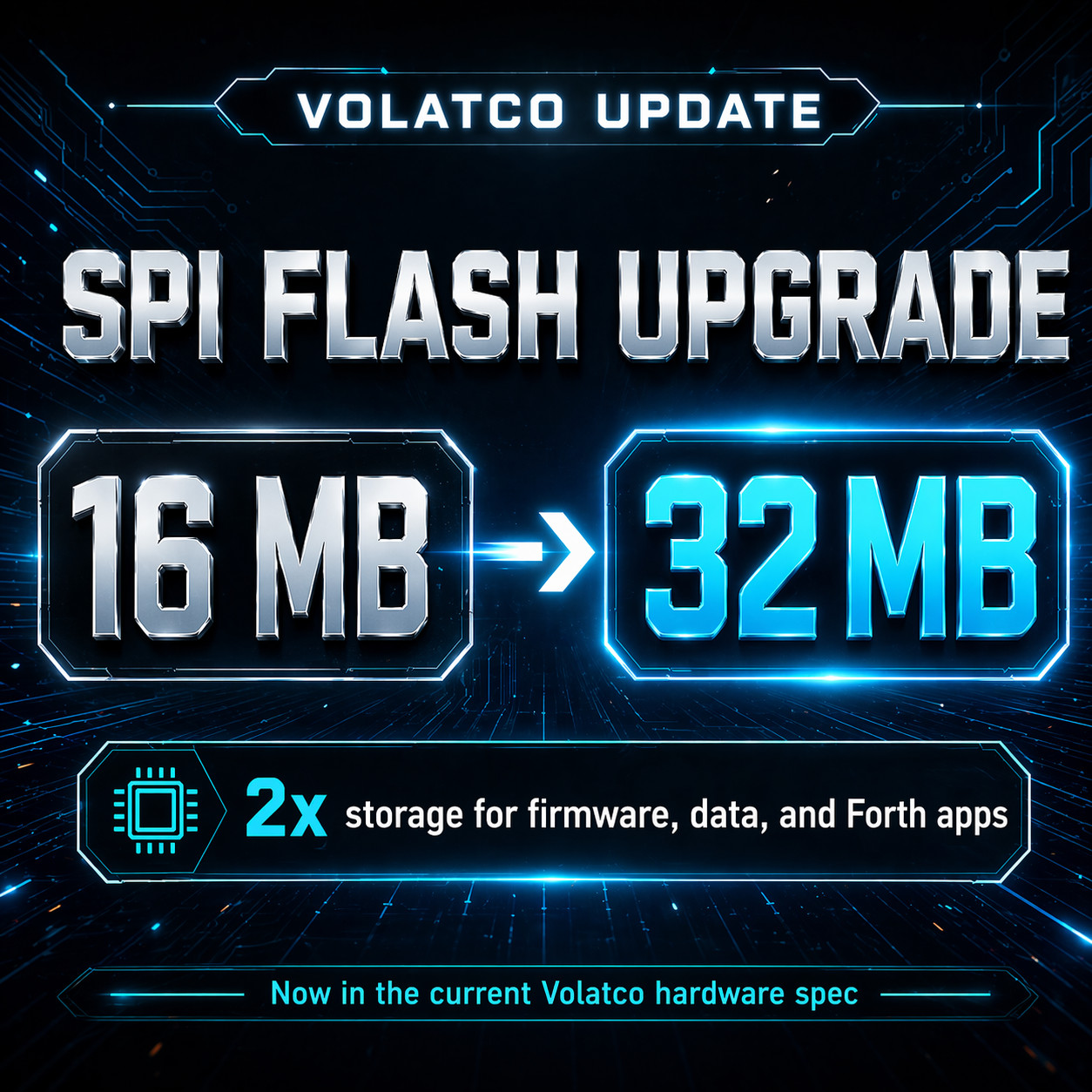
Memory: 2 MB SRAM and 32 MB SPI flash
A persistent computing platform that never forgets
Workflow persistence as a hardware property
State-transitioning mesh context-as-runtime
Say goodbye to garbage collection
Built for post-cloud intelligent systems
Hardware update: SPI flash capacity has been increased to 32 MB in the latest board revision - Model 'C'.
Architecture Mapping
Apeiron on Volatco
Apeiron is the learning-first agent architecture that fits Volatco best: an open-ended system that expands its behavioral repertoire over time instead of freezing behavior into one static policy.
Volatco supplies the substrate for that approach by letting many small F18A nodes stay local, specialized, and continuously available for low-latency coordination.
That is the practical meaning of the hybrid: the machine and the language evolve toward each other until the work begins with the problem, not with tool anxiety.
Built for control and adaptation
Volatco is intended for machine-intelligent systems where deterministic behavior, low latency, and graceful degradation are more valuable than cloud-scale dependency.
Each F18A node can transition between active and suspended behavior on extremely small time scales, allowing systems to allocate compute only when needed instead of keeping all logic continuously active.
Service mesh to grow your code
Each GA144 chip on Volatco contains 144 F18A nodes and supports rich interconnection using polyForth Ganglia and Snorkel to create ambient phasic state meshes for contemplative decision-making programs.
This approach lets you scale behavior as cooperating local services instead of forcing everything through a single centralized runtime path.
That same mesh model also makes room for higher-order agent behavior, where coordination, supervision, and adaptation can emerge from many small local services instead of one fixed central runtime.
Apeiron through the mesh
Apeiron fits naturally into this service-mesh view, where learning, supervision, recall, and local control can live across cooperating nodes instead of one monolithic agent process.
The mesh is not just transport. It is part of how Apeiron stays adaptive, distributed, and close to the machine.
Apeiron layers
Boundless core
Skill formation and composition live across local node clusters, allowing new behaviors to be assembled from reusable words, services, and state transitions rather than baked into one monolith.
Adaptive control plane
Nearby nodes handle fast control loops directly, while Ganglia and Snorkel coordinate lower-frequency scheduling, discovery, arbitration, and major reconfiguration events.
Versioned self-model
The agent's current goals, competencies, and operating assumptions can be stored as persistent distributed state, so identity is treated as revisable runtime structure instead of a permanent constant.
Boundary layer
Hard resource ceilings, power envelopes, actuator limits, and watchdog logic define the edges of safe growth so learning capacity does not override control.
Telemetry and signal fabric
Ganglia is the observability channel for health, metrics, and coordination status. Snorkel provides the path for querying nodes, shipping supervision signals, and retasking unused capacity.